
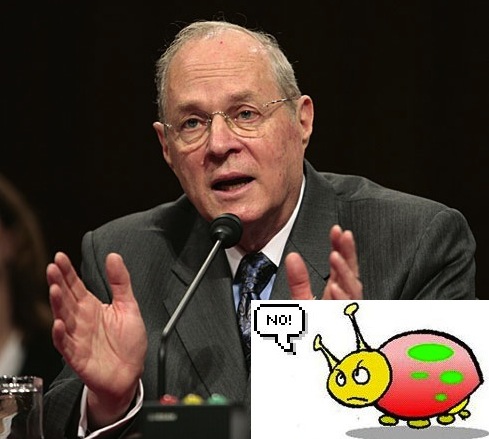
The Supreme Court issued a decision (5 to 4) today that it is not a violation of the Establishment Clause of the Constitution for Arizona to give tax credits to people who donate to a scholarship fund that is used to provide scholarships to students to attend private schools, of which many are religious schools. In explaining the majority decision, Anthony Kennedy says that a reason that this is not a violation of the Constitution is that the state of Arizona is merely providing tax credits which support religious schooling, rather than actually spending state money on religious schools:

It is easy to see that tax credits and governmental expenditures can have similar economic consequences, at least for beneficiaries whose tax liability is sufficiently large to take full advantage of the credit. Yet tax credits and governmental expenditures do not both implicate individual taxpayers in sectarian activities. A dissenter whose tax dollars are “extracted and spent” knows that he has in some small measure been made to contribute to an establishment in violation of conscience. Flast , supra, at 106. In that instance the taxpayer’s direct and particular connection with the establishment does not depend on economic speculation or political conjecture…. When the government declines to impose a tax, by contrast, there is no such connection between dissenting taxpayer and alleged establishment. Any financial injury remains speculative.
This argument is obviously completely bogus, as Elena Kagan explains in her dissent:
Our taxpayer standing cases have declined to distinguish between appropriations and tax expenditures for a simple reason: Here, as in many contexts, the distinction is one in search of a difference. To begin to see why, consider an example far afield from Flast and, indeed, from religion. Imagine that the Federal Government decides it should pay hundreds of billions of dollars to insolvent banks in the midst of a financial crisis. Suppose, too, that many millions of taxpayers oppose this bailout on the ground (whether right or wrong is immaterial) that it uses their hard-earned money to reward irresponsible business behavior. In the face of this hostility, some Members of Congress make the following proposal: Rather than give the money to banks via appropriations, the Government will allow banks to subtract the exact same amount from the tax bill they would otherwise have to pay to the U. S. Treasury. Would this proposal calm the furor? Or would most taxpayers respond by saying that a subsidy is a subsidy (or a bailout is a bailout), whether accomplished by the one means or by the other? Surely the latter; indeed, we would think the less of our countrymen if they failed to see through this cynical proposal.
The fact is that tax credits and government expenditures are functionally the same thing. For an example in addition to Kagan’s, consider how the English handle charitable donations: rather than giving you a tax deduction when you donate money to a charity, the government just donates additional money, above and beyond what you donated, to the same charity. This English system is mathematically equivalent to ours, as long as the numbers are aligned correctly (e.g. in the U.S. if you donate $100 to a charity and your tax rate is 30%, the govt. gives you a $30 rebate. In England, you’d just donate $70 to begin with, knowing that the government would then add $30 to your donation.)
We all expect that the Supreme Court justices can honestly disagree with one another on matters of interpretation and value judgments. But this seems to be a case where one justice’s opinion relies on what is basically an objectively false understanding of how money works. We should not let our justices get away with this. The media should shame Kennedy. But given that they generally ignore things like this, I hope Elena Kagan has shamed Kennedy, and made him feel silly. When I make objectively incorrect arguments in the workplace, I can expect others to point out my error and have a little fun doing it, and the humiliation I feel motivates me to be more careful next time. We should hold our justices to a much higher standard. They are probably smarter than the rest of us on average, but apparently not by so much that they don’t need to be whacked back into line through media scrutiny and humiliation once in a while.
Pingback: Did Kennedy Really Blunder? | Rousing the Hobgoblins